0 Items In Cart
No products in the cart.
Your privacy
Choose which cookies we can use. Your choice is saved for 12 months, and you can change it at any time from Cookie Settings in the footer. Read our Cookie Policy.
Needed for the site to work, such as your cart, checkout and account sign in. These cannot be switched off.
Remember your choices, such as your wishlist and recently viewed rugs, so the site feels personal.
Help us understand how visitors use the site so we can improve it. The data is collected in aggregate.
Used by our advertising partners to show you relevant Magic Rugs ads on other sites.
Table of Contents
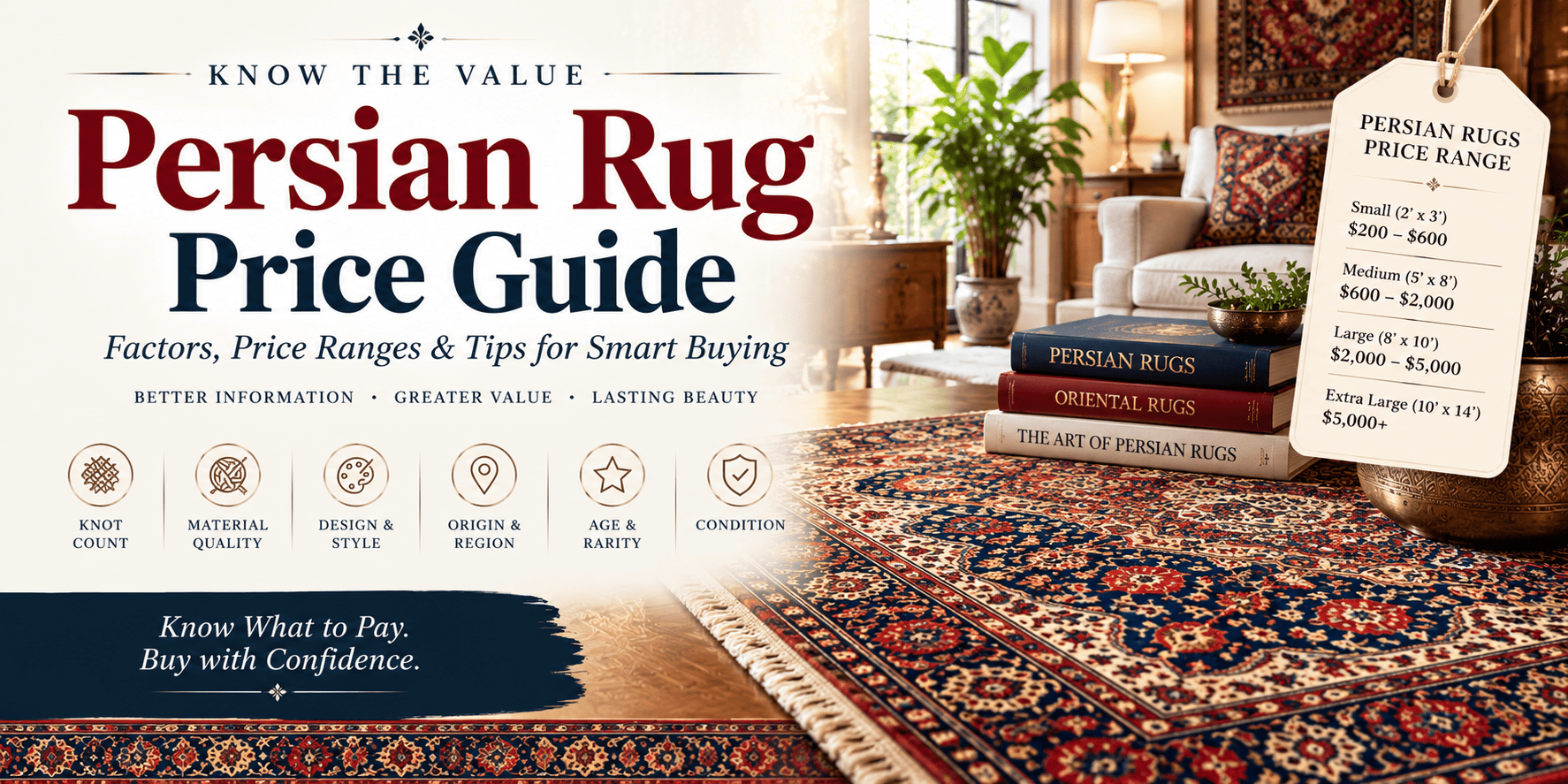
If you are thinking of buying a Persian rug in 2026, you may be surprised to know that the cost of a Persian rug is changing drastically.
From smaller-sized handmade rugs to delicate silk or antique Persian rugs, prices range from a few hundred dollars to thousands of dollars, or even ten thousand dollars.
But how much should you exactly pay to buy a genuine Persian rug in 2026?
A genuine hand-knotted Persian rug generally costs somewhere around hundred dollars to $10,000 or more, depending on its size, material, knot density, age, origin, and condition.
Magic Rugs currently has Persian rugs in the range of $100 to more than $10,000. Excellent pieces ranging from more than $10,000 show how vast the market can be.
The key is to focus on the value, instead of searching for the lowest price. It is about finding the balance among size, type, and quality.
For a genuine handmade Persian rug, the average price in 2026 ranges between:
Rug Type | Typical 2026 Price Range |
Small handmade Persian rug | $300-$1,000+ |
Medium wool Persian rug | $800-$3,000+ |
Fine hand-knotted Persian rug | $2,000-$8,000+ |
Silk Persian rug | $300-$15,000+ |
Vintage Persian rug | $500-$10,000+ |
Rare antique or collectible rug | $10,000-$50,000+ |
Note: These are approximate values, not fixed prices. The exact value usually depends on size, materials, age, design, and overall condition of the rug. However, the general market idea shows that handmade wool rugs can differ depending on a per-square-foot basis. |
The cost evaluation of a Persian rug becomes more manageable when you keep a few factors, like construction and quality, in mind while purchasing a rug rather than just focusing on the size alone.
Type | Quality | Price Range(approx.) |
Machine-made Persian-style | Average | $100-$800 |
Hand-knotted wool | Good | $500-$3,000+ |
Fine wool | Excellent | $2,000-$8,000+ |
Wool and Silk | Premium | $2,000-$10,000+ |
Fine silk | Luxury | $3,000-$15,000+ |
Antique or rare | Collectible | $10,000+ |
It is completely possible for two Persian rugs to have similar sizes but extremely different prices. These are the main factors that determine the price:
Machine-made rugs are usually more pocket-friendly and are considered a great choice for budget-conscious buyers.
However, handmade Persian rugs are time-consuming and require more skill to produce than machine-made ones. In handmade rugs, single knots are tied by hand, that is why weaving takes more time and adds to the price.
Most Persian rugs are made from wool because it is long-lasting, comfortable, suitable and relatively low maintenance.
At the same time, silk is finer and provides a distinct aesthetic appeal, but it is more delicate, which makes its price range higher. Wool-and-silk blends fall between the two, providing an excellent balance between feel and price.
KPSI stands for knots per square inch. It measures the total number of single knots tied in a rug. Usually, higher KPSI implies finer quality, but it doesn’t automatically make a rug better quality.
For quality, other factors such as materials, design, construction, craftsmanship, and origin matter too.
The age and overall condition of a Persian rug usually affect the price, but being older doesn’t always imply more valuable.
More specifically, a well-preserved vintage piece with excellent features, fine colors, and bold construction makes a rug more attractive than an older rug in bad condition.
However, antique Persian rugs become more expensive due to their rarity, good condition, and origin.
The selection of Persian rugs also depends on your budget, how much you can spend and whether you can afford to buy a particular category.
In this budget, you will get smaller handmade options, runners, vintage rugs, or simpler wool designs. This budget is enough to start if you want to buy a genuine handmade Persian rug without spending more.
In this mid-range, you will usually get medium-sized handmade wool rugs, intricate designs, and some other vintage options. Many rug buyers find this a better combination of quality and price.
In the Premium range, you may find larger rugs, finer knots, good-quality materials, intricate rugs, and high-end vintage pieces.
Luxury Persian rugs usually include premium silk rugs, rare antiques, highly intricate pieces, or rugs with unique origin and craftsmanship.
Size is one of the easiest ways to bring down your budget, but make sure you don’t compromise on quality, it still matters.
Size | Typical Budget for Handmade Persian Rug |
2×3 | $300-$1,000+ |
3×5 | $400-$1,500+ |
4×6 | $600-$2,000+ |
5×8 | $800-$3000+ |
6×9 | $1000-$4,000+ |
8×10 | $1500-$6,000+ |
9×12 | $2,000-$8,000+ |
10×14 | $3,000-$10,000+ |
The mentioned price ranges are only starting points. Current pricing data for 2026 shows that larger hand-knotted wool rugs have shifted to a higher price-per-square-foot range.
The price valuation of a Persian rug has become complex, the market in 2026 is not at all simple. Prices are increasing day by day. Different parts of the market work differently.
The fact is that genuine handmade Persian rugs will always be priced higher, as they are made with high-quality materials by skilled labor and usually need more weaving time. Now in 2026, machine-made rugs have become more common and are popular for their affordability, they even fit a smaller budget.
Moreover, larger size, higher knot density, and unique patterns also affect the price ranges as well.
Nowadays, the interest and demand for vintage, tribal, and antique rugs are growing, as they add personality to the space without looking overwhelmed and new. This implies that buyers get different price options, but comparing construction and condition is also important.
However, one of the most important factors affecting the price range in 2026 is the level of complexity and individual craftsmanship.
Before paying an extra price, make sure to follow these factors.
Confirm Construction: Make sure to check whether the rug is handmade or machine-made.
Check the material: Before investing in a rug, know about the material, used one is wool, silk, or a blend.
Look at the KPSI: Besides, it is advisable to use the KPSI as a quality factor, not the only factor.
Check the Origin: Before finalizing the rug, it is highly recommended to check the actual origin of the rug rather than only depending on the design.
Review the Condition: Before making a purchase, make sure to check the condition of the rug thoroughly, from stains and repairs to fading, damage, and earlier restoration.
Check the Return Policy: Review the return policy when buying online, usually, companies provide 30-day easy returns.
Ask Questions: The seller should be willing to answer all the queries regarding the cost of the rug.
It is completely possible to get a beautiful high-quality Persian rug without spending thousands of dollars.
In living rooms, dining areas, and most used areas, you can use good-quality wool rugs that offer excellent long-lasting quality and affordability that can fit any budget.
Moreover, it is important to know that vintage Persian rugs usually offer excellent handmade craftsmanship at a more reasonable price range than new exclusive pieces. You need to check the condition of the rug before buying.
When shopping for a handmade Persian rug, it is recommended to closely check the knot density, which usually works as a quality indicator. A moderate knot density creates a better balance between the price and quality for daily use. You do not always need the highest knot density.
Lastly, before purchasing the rug, you should know the placement, foot traffic, and required size of the rug. There is no benefit in paying more for a sensitive silk rug, as it doesn’t make sense to place it in a high-traffic family room.
There is no particular fixed or correct price range for Persian rugs in 2026. The right price is not always the cheapest or the most expensive; basically, the correct price range depends on what you are getting in return for that rug’s value.
For most buyers, a handmade wool Persian rug price range is $1,000-$3,000, it is an excellent balance of quality, durability, size, and worth. You have to spend more for high-end material, increased knot density, larger sizes, or an antique piece.
Remember that the value of a rug depends on its construction, materials, size, age, condition, and seller. So before comparing prices, make sure to consider these factors.
To buy a better-value Persian rug with consideration of the mentioned factors, you can visit and browse different styles, sizes and price ranges at Magic Rugs and buy a rug that matches your budget and space.
A handmade Persian rug can cost anywhere from a few hundred to several thousand dollars. However, fine silk and rare antique pieces can also cost $10,000 or more. The price depends on construction, materials, size, age, condition, and craftsmanship.
Persian rugs are hand-knotted designs, made using high-quality wool or silk. Their making process requires more skilled labor.
Larger-sized rugs and designs with more detailing and better construction need more time to complete. Moreover, a Persian rug’s condition, age, rarity, and origin can cause price increases.
Many factors affect the price of a Persian rug. Thus, it is important to ask the seller about the size, materials, construction, and origin of a rug when purchasing.
Remember that smaller handmade wool, vintage pieces, and rugs with simple designs offer better value, and affordable rugs can also provide better quality.
For many homeowners, a 5×8 or 6×9 Persian rug gives the best value and good coverage. However, the price is usually based on the room and furniture layout. A smaller, high-end rug is always better to choose than a lower-quality, larger rug.
Most often, rugs that are antiques, handmade, high quality, and rare tend to increase in value. The increase in price also depends on factors like rarity, age, condition, materials, origin, and market demand.
However, the price of some Persian rugs can increase, but it is not guaranteed. It is best to shop for a Persian rug because of its quality and design instead of treating it as a guaranteed investment.
Rug Guide
Rug Guide
Rug Guide