0 Items In Cart
No products in the cart.
Your privacy
Choose which cookies we can use. Your choice is saved for 12 months, and you can change it at any time from Cookie Settings in the footer. Read our Cookie Policy.
Needed for the site to work, such as your cart, checkout and account sign in. These cannot be switched off.
Remember your choices, such as your wishlist and recently viewed rugs, so the site feels personal.
Help us understand how visitors use the site so we can improve it. The data is collected in aggregate.
Used by our advertising partners to show you relevant Magic Rugs ads on other sites.
Table of Contents
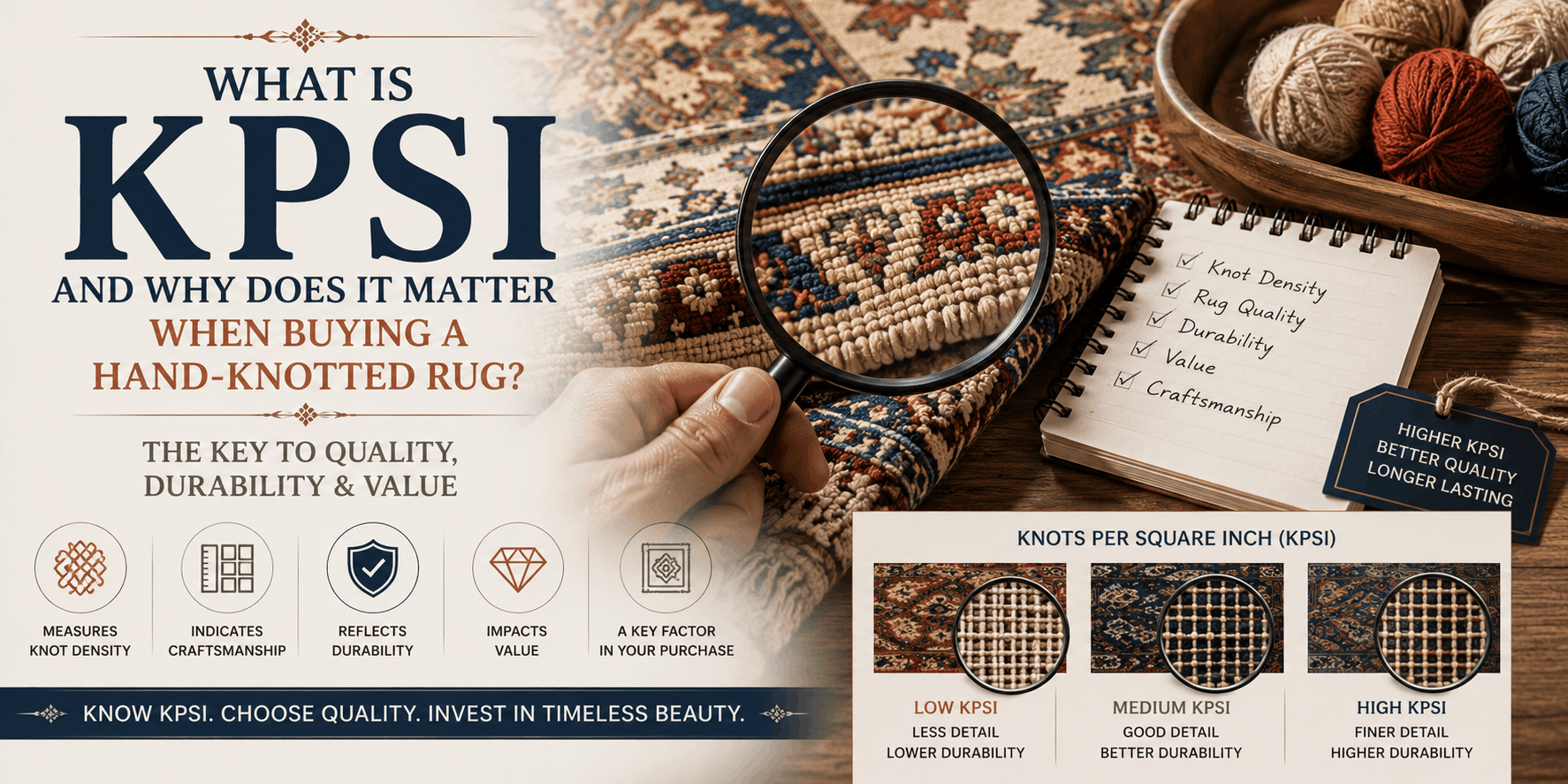
KPSI is the term used for Knots Per Square Inch, it measures the number of knots used in one square inch in a handmade rug. It helps to understand a rug’s weave density, pattern’s finesse, craftsmanship, design detailing, and its price.
You cannot define a rug’s quality or durability only on the basis of KPSI, factors such as material, dyes, knot type, age, origin, and construction also need to be considered. A higher KPSI implies finer patterns and detailing.
KPSI helps homeowners compare Persian, Oriental, Turkish, and other handmade rugs. It is essential to help you understand the reason why two rugs of the same size have different prices.
This guide discusses more about KPSI, its use, how it is related to rug making, why it matters, and also covers other elements that should be kept in mind that affect knot density.
Key Takeaways
KPSI indicates the number of knots per square inch in a handmade rug.
KPSI measures the knot density in a handmade rug.
Higher KPSI generally represents finer patterns, tighter weave, and detailed designs.
Higher KPSI means a higher price because of extra labor costs.
KPSI individually does not define the quality, a rug’s materials and craftsmanship also matter.
KPSI, knots per square inch, indicates how many knots have been tied in one square inch to make a handmade rug. A higher KPSI generally implies more knots are confined in the same area, making a finer design with more intricate patterns and weaving.
Let's suppose a rug with 100 KPSI has around 100 knots tied within one square inch, whereas a rug with 200 KPSI has double the knot density.
A higher number of knots tied within the same area and extra density generally allows weavers to make finer, more detailed designs, smaller motifs, and a denser weave. The density of a handknotted rug only indicates how tightly its piles have been woven together.
To measure KPSI, count the number of knots across one inch of the rug’s surface, then count the knots that have been going downwards in another direction. After that, you have to multiply the two numbers to calculate knot density.
| For example, if you have 10 knots tied across in one inch of the rug’s surface, and 10 knots have been tied downwards, then the KPSI value would be 100 =10 x 10. |
Warp threads run lengthwise through a hand-knotted rug, and weft threads run horizontally or across the rug. Knots are tied around the base threads to create a pile. All of these elements together create the basic structure of a hand-knotted rug.
The warp threads are generally not visible when a rug is being viewed from the front, while the weft threads and knots are visible. The exact construction of a rug can vary considerably in different parts of the world, so it is important to consider KPSI with the rug's origin and knotting technique.
KPSI matters when purchasing a hand-knotted rug as it helps to indicate the weave density, design detailing, labor, and construction of the rug. KPSI means how many knots are tied within one square inch of a handmade rug.
This is essential when you have to compare similar hand-knotted rugs such as Persian, Oriental, and Turkish. For these reasons, it is important to pay attention to a rug’s KPSI when purchasing a hand-knotted rug.
For homeowners, however, the motive should not be to search for the rug with the highest KPSI, but to generally understand what you are purchasing and then decide if the rug matches your space, budget, and personality.
Let’s discuss how KPSI matters when buying and comparing handmade rugs:
A higher KPSI generally represents more intricate patterns and finer designs in a hand-knotted rug. Lower KPSI values, on the other hand, allow for larger, more dramatic design elements that generally appear to be tied less tightly together.
A rough and low KPSI weave generally makes a rug more suitable for high-traffic areas. Lower KPSI, on the other hand, allows for bolder design elements and a rough appearance.
Finer Persian and Oriental rugs generally have higher KPSI and are valued more than coarser tribal and village rugs. Lower KPSI rugs have large intricate floral patterns, geometric motifs, and fine medallion designs that generally require more knots to be tied within a smaller area.
The knot density of a rug is only one factor that impacts its ability to handle years of use and still maintain its quality. The value of a rug is impacted by a combination of elements, including its KPSI, design details, the rug’s material, construction method, and the after-purchase care.
Wool rugs are generally more durable than silk rugs and should be considered for high-traffic areas. Wool quality, foundation, pile weaving method, and proper maintenance on a regular basis also impact their lifespan.
The higher the KPSI of a hand-knotted rug, the more it will cost, as it takes more time, skill, and labor to tie more knots to create the rug. The KPSI value alone is not used to determine the value of a hand-knotted rug. However, the combination of a rug’s knot density and other elements determines its value.
The value of a rug is affected by a combination of elements, that are origin, design, materials, quality, KPSI value, and condition. Persian or Oriental rugs been created using a fine weave are priced higher than a similar rug that has a coarser weave, like tribal rugs.
A rug’s KPSI value helps to evaluate the rug and identify whether the rug is hand-knotted, but it cannot ensure its authenticity alone. A seller should be able to provide more details, including information on the rug’s construction, knots, edges, material, and other elements to check the craftsmanship of the handmade rug.
You should always check the rug’s back. Hand-knotted rugs generally do not have a completely uniform pattern, as the knots within them are tied by hand. Variations in pattern and knot size are usual and are part of handmade construction.
There is no universal KPSI value that indicates low, good, or fine knot density, it differs for different rug styles. The following KPSI ranges help you know general knot density values:
KPSI Range | General Density | Typical Design | Suitable Use |
Less than 80 | Rough | Dramatic tribal or geometric designs | Casual and rustic rooms |
80-150 | Medium | Traditional and transitional designs | Everyday living spaces |
150-300 | Fine | Intricate floral and medallion designs | Formal living rooms |
Over 300 | Very fine | Very detailed | Luxury areas |
Note: These are only general guidelines that should be used as a reference when purchasing a hand-knotted rug.
The KPSI values differ from region to region as different rug styles use different knots, construction methods, materials, and designs. Persian rugs generally have a higher KPSI than other types of hand-knotted rugs.
This is largely because of the intricate patterns and knots that are generally found in Persian rugs. The KPSI values should be compared on the basis of different rug styles instead of considering one number as a universal standard.
Hand-knotted Indian and Pakistani rugs range in different KPSI values, materials, designs, and other elements. The quality of these rugs should be analyzed by using knot density, wool quality, construction, dye quality, design, and craftsmanship.
Make sure to compare rugs with the same construction and materials before using KPSI to check which provides better value.
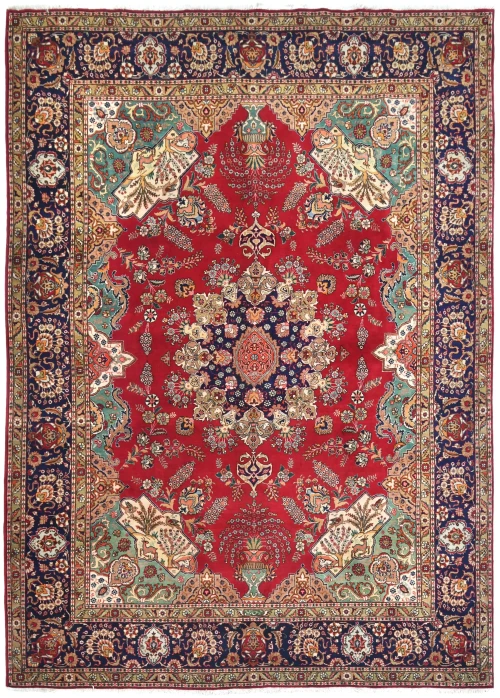
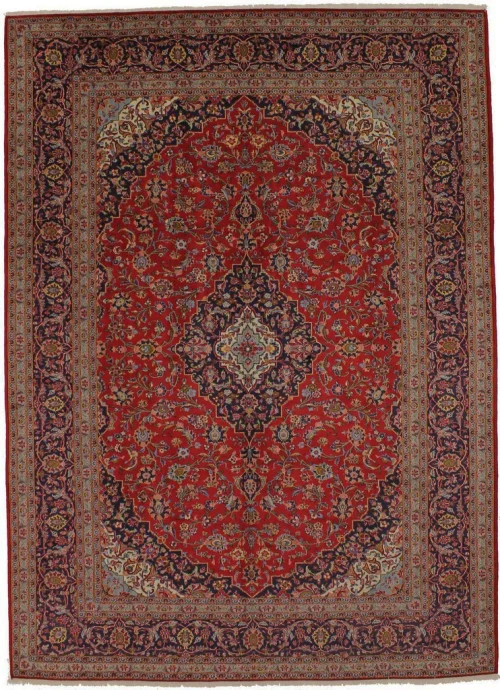
Persian rugs from Tabriz, Isfahan, and Qum generally have a higher KPSI because of their intricate floral patterns, medallions, and finer detailing; they generally require more knots to tie within a smaller area.
This does not mean that lower knot density rugs are not desirable, since lower knot density rugs can be used in high-traffic areas and are generally low in cost.
Turkish and Caucasian rugs generally have a lower KPSI than Persian rugs since their bolder designs generally do not require as many knots to be tied within a square inch.
This does not mean that these rugs are of lower quality, however. As they generally have bolder design elements, these rugs should be evaluated separately when considering knot density.
Higher KPSI indicates that more knots have been tied to create the rug, increasing its intricacy and detail, but it does not necessarily indicate better quality, excellent durability, or higher value.
KPSI should be considered as one element to evaluate the quality of a hand-knotted rug instead of the entire picture.
A lower KPSI can be the right choice for tribal and village rugs, as their bolder designs generally do not need fine knot density.
These types of rugs can also be used in high-traffic areas, as their coarser weave is generally more durable. A coarser weave also often has a more casual appearance, which goes well with large geometric designs and traditional patterns.
They look appealing in a casual living room or other farmhouse-style areas or rustic-style interiors. A rug with a low KPSI can be the best choice for specific rugs, depending on a variety of factors, as it provides the look you want to create.
KPSI is an important consideration when evaluating a hand-knotted rug, but it cannot individually determine the quality of the rug.
The materials used to construct the rug, color quality, age, construction, consistency of the knots, origin and condition all of these factors should also be analyzed and matter as much as KPSI in rug quality.
High-quality materials like wool and excellent craftsmanship generally make a rug more long-lasting and helps remain in good condition for years.
Before purchasing the rug, its care, looks, feel, and functional requirements should also be considered instead of focusing only on one factor.
You can get the idea of a rug’s KPSI by turning it over and analyzing it by turning it over and counting how many knots have been tied within an area of one square inch. After that, multiplying the two numbers counted gives you an approximate idea of knot density.
This simple check can help you understand whether the obtained KPSI looks reasonable. This will provide an approximate idea of knot density that can be used for general comparison purposes.
Buyers should ask rug sellers about a rug’s KPSI, including how it was calculated. This allows buyers to ensure that the rug is genuinely hand-knotted, as machine-made rugs do not generally have knots that have been tied by hand.
Buyers should also ask sellers about the rug’s origin, material, age, condition and other relevant factors. A genuine seller will easily explain the rug rather than just focusing on the KPSI.
Be aware of fake claims if a seller is unusually promoting high KPSI values without explaining how it was measured and calculated. It indicates that a hand-knotted rug having higher KPSI implies high quality. A rug’s back provides a proper idea and visual indication of its knot density.
You should always ignore misleading information regarding a rug’s knot density, and buyers should research knot density values for different types of hand-knotted rugs before making a purchase.
KPSI is not the only component that should be considered to analyze rug quality when purchasing a hand-knotted rug. Other quality factors should also be checked, including materials, knot density, construction, design, and other elements.
The following chart displays more about the other rug quality metrics that should be analyzed:
Quality Metric | What it Measures | Why it Matters |
KPSI | Knot density | It indicates finer weaves |
Knot Type | Knotting Method | It shows construction and weaving tradition |
Materials | Wool, silk, cotton | It impacts feel and performance |
Weaving strength | Overall Structure | It affects stability and appearance |
Pile | Pile height and texture | It impacts wear |
Condition | Wear and damage | It affects value and longevity |
KPSI can be used as a guide when choosing a rug for your home, but it should not be the only factor in making a decision. KPSI indicates how many knots have been tied to create a hand-knotted rug.
Understanding KPSI helps you buy a hand-knotted rug confidently, but you should not completely depend on it. Also consider other factors such as its pattern detailing, design, age, craftsmanship, origin, condition, and your room’s requirements.
Before buying a rug for your home, make sure to check KPSI along with other elements that need to be reviewed together so that you can easily choose the best quality rug option.
If you are looking for a seller who provides fine-quality hand-knotted rugs, has high-quality materials and offers excellent-quality Persian and Oriental handmade rugs, Then, Magic Rugs can help you pick a rug based on the best combination of elements. From good material to excellent craftsmanship, we focus on each element, rather than just depending on a single knot density value.
A KPSI value ranging between 80 and 150 indicates medium knot density, while a value that ranges between 150 and 300 indicates fine knot density. A good KPSI for a handmade rug depends on its origin, materials, design, construction, and condition, along with knot density.
Higher KPSI means a higher price for a rug, as it indicates that more knots are hand-knotted manually, which requires more labor and extra weaving time. But a rug’s origin, materials, construction, age, rarity, condition, and craftsmanship also impact its price.
A rug’s knot density can be checked without a certificate by measuring the number of knots that have been tied within one square inch. Multiply the number of knots running vertically and horizontally to get KPSI.
No, machine-made and hand-knotted rugs cannot be compared, as the production process that has been used to create them differs considerably. Therefore, knot density measurements should not be used to compare quality accurately with hand-knotted rugs.
Look for KPSI depending on the rug’s design, use, and budget. A Persian rug’s KPSI should not be analyzed on its own, as it must be compared to the knot density of similar rugs. Detailed Tabriz, Isfahan, or Qum designs may benefit from higher KPSI, while dramatic Persian rug styles go well with lower KPSI.
KPSI can impact a rug’s construction and surface, but a rug’s fibers and pile height generally have a much stronger impact on its feel. Two rugs with a similar KPSI can feel completely different when made from different materials.
Yes, a KPSI value of 300 for a rug is generally considered to be a fine knot density, especially when compared to tribal or everyday rugs. Some extremely fine rugs, especially silk, can have an even higher KPSI value.
Yes, a low-KPSI rug can still be highly valuable because KPSI does not determine worth, it also depends on other factors such as its quality, materials, craftsmanship, detailed designs, condition, and colors. All of these contribute to increasing the value.
Rug Guide
Rug Guide
Rug Guide