0 Items In Cart
No products in the cart.
Your privacy
Choose which cookies we can use. Your choice is saved for 12 months, and you can change it at any time from Cookie Settings in the footer. Read our Cookie Policy.
Needed for the site to work, such as your cart, checkout and account sign in. These cannot be switched off.
Remember your choices, such as your wishlist and recently viewed rugs, so the site feels personal.
Help us understand how visitors use the site so we can improve it. The data is collected in aggregate.
Used by our advertising partners to show you relevant Magic Rugs ads on other sites.
Table of Contents
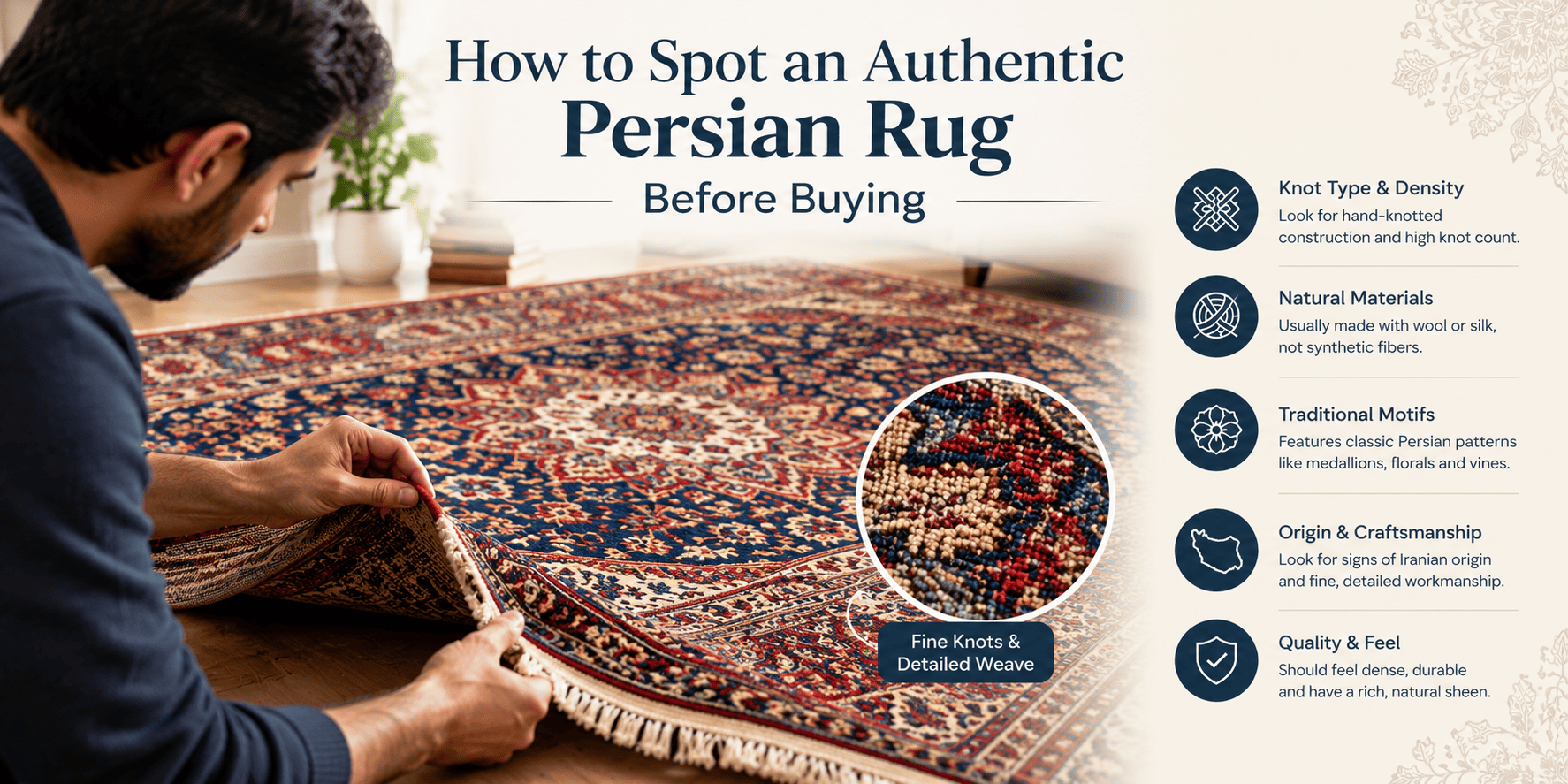
Buying a Persian rug requires much more effort than choosing a beautiful pattern. Before buying a rug, you should have complete, detailed information about it, including its origin, construction, and whether the quality it provides is worth the price.
However, traditional patterns and vibrant colors appear properly on the back of both handmade and machine-made rugs, making it tough to distinguish them at first glance. To spot an authentic Persian rug, you should always check its construction, materials, back, fringes, and detailed information about its origin.
Comparing these factors helps you make a confident decision, but you should always ask questions of the rug seller about the history and craftsmanship of the rug.
A real Persian rug originates from a country called Persia and consists of traditional designs, handmade construction and intricate craftsmanship.
To spot a genuine Persian rug, look at its back and check the knots and fringes, touch the material, and ask the seller to provide complete information about the construction and origin of the rug.
You should know that no single clue can justify that a rug is genuine. You should carefully check some factors before making a purchase decision.
Authenticity of a rug matters as it allows you to check what you are buying and whether its price is worth it and within budget.
However, the value of a handmade authentic rug depends on various factors such as the materials used to make it, the rug’s design, origin, craftsmanship, and its condition, but they don’t directly make every rug costly or best for every home.
A well manufactured Persian rug lasts for centuries when maintained well. The life of a rug depends on the materials, knot density, construction, foot traffic, and maintenance.
As Persian rugs need more time and skilled labor to manufacture, they are costly. The rug’s size, material, condition, and design also affect its price.
Some aged Persian rugs are historical and are good for investment because of their age, history, origin, and condition. It doesn’t mean that every genuine Persian rug is an investment that will increase in price.
When buying a Persian rug, just considering the front design will not work. You have to consider these signs to help you evaluate its construction and determine what to ask the seller before buying a rug.
To check the construction, the buyer has to look at a rug’s backside to check the knots and pattern. Traditional hand-knotted rugs usually have individual knots on their back. Whereas a machine-made rug, on the other hand, may usually have a more uniform construction.
Many traditional Persian rugs are usually made up of wool, silk, cotton, or a blend of fibers. Wool mostly offers a warm and strong feel, while silk is the softest and finest among all of these fibers, but only the touch alone cannot tell you about the material.
In handmade rugs, the design is properly visible on the back, with right knot spacing and coordination. However, inconsistency alone cannot tell about authenticity, as some handmade rugs have regular patterns.
The most common types of dye are used in traditional Persian rugs and in their respective place of origin, which usually impacts their design and materials.
Check whether the dyes used work well with the rug's construction and age, it is better to ask the seller directly about the dyes instead of assuming that the colors used are rich.
The fringe is made up of base threads that come out of the rug. If the fringe is connected or sewn on, you should ask the seller for more information, like the construction, the repair or finishing process may also differ.
Handmade rugs usually have slight differences in their pattern, spacing, color, or knot placement. These variations are part of the construction, but they are not proof of a genuine rug, as machine-made rugs also copy the look of handmade Persian rugs.
A genuine rug seller provides detailed information about the rug’s history, origin, material, and construction. Always ask for a relevant certificate or document that tells about the age, origin, or value.
Use this checklist before buying a rug to ensure its authenticity and check the factors you should consider before paying.
The seller should know about the rug’s origin of any Persian rug.
Check the construction: whether the rug is handmade, flatwoven, tufted, or machine-made.
Ask for clear front and back photos of the rug.
Check the rug’s material and its composition in detail.
The fringe should be tied to the foundation.
The edges should be well finished.
You should know about the type of dye used and whether the material is natural or synthetic.
Check the condition of a rug, including any signs of repair, wear, or damage.
Request complete documentation for particular age or origin claims.
The price should reflect the rug’s age, material, size, and craftsmanship.
Ask the seller for a refund or return policy, especially if you are purchasing online.
Not all the rugs that look traditional are genuine, and not every genuine Persian rug has similar features. Knowing these common myths can save you from spending extra money, just on the basis of assumptions.
Most of the traditional rugs are handmade, there are also machine-made rugs influenced by handmade Persian rug designs. Always review the rug construction and the description before buying rather than just depending on the pattern.
Genuine Persian rugs are made with natural, chemical, or mixed dyes. The type of dye used doesn’t tell you about the authenticity, ask the seller for complete information if it impacts your purchase.
A costly rug usually means a rug is genuine or good in quality is a myth, not all costly rugs are worth investing in. Always check the rug’s materials, condition, size, origin, and construction details before determining if the price is worth investing.
Some handmade Persian rugs look appealing to homeowners, but there is no guarantee of resale in future. Always go for a rug depending on its quality, comfort, and look rather than buying thinking that its price will increase.
Before choosing a Persian rug, it is important to ask the right questions from the rug sellers to make sure that you make the right purchase.
A genuine seller will give the right answers and a proper explanation when they cannot verify.
Is the rug handmade or machine-made? Ask for close-up photos to check the rug’s back and construction.
Is the rug made from wool, cotton, or silk materials? Check the material to determine whether the rug is made using wool, silk, cotton, or a blend.
Is the rug new, vintage, or antique? Ask the seller to share information and pictures that confirm the rug’s age.
Is there any damage in the rug? Check for stains, repairs, fading, and frayed edges in the rug.
What is their return policy? Make sure that the seller has a return policy to return the rug if it is not received as described.
Always make sure that the product listing has all the necessary information about the materials, size, origin, and construction before buying the rug online.
To recognize a genuine Persian rug, consider several factors instead of focusing only on one single clue. Before buying a rug, always check its knots, materials, construction, and fringes.
Also make sure that the seller provides all the necessary information about the rug’s origin, construction, and materials. Always evaluate the same rug pieces and know what you are exactly buying and spending money on before making a purchase decision.
At Magic Rugs, we have a wide range of authentic Persian rugs in different materials, styles, and sizes to fit well with your home, preferences, and budget.
The country of origin, construction, materials, back pattern, and fringe of the rug can tell you if a Persian rug is genuine. Always ask the rug seller to provide complete information and documentation about the rug, specifically whether the rug is handmade or antique.
No, not all traditional Persian rugs are handmade, some machine-made rugs with Persian features are also available. Before buying a Persian rug, always check its construction to know how the rug was made.
No, some real rugs have labels or information, some do not. A single label cannot tell you a rug is genuine. Always check the description shared by the seller about the rug’s origin, materials, and construction details to know more about it.
Most traditional Persian rugs are made with wool, silk, or cotton material or their blend. The actual materials are based on the rug’s style and construction. Ensure that you know the materials before buying a rug.
Yes, fake rugs can look handmade because of the copied designs of handmade rugs. The traditional patterns, texture, and colors are also there in other machine-made pieces. Before buying, check the back and construction, compare materials, and ask the seller to provide information about its origin.
Rug Guide
Rug Guide
Rug Guide