0 Items In Cart
No products in the cart.
Your privacy
Choose which cookies we can use. Your choice is saved for 12 months, and you can change it at any time from Cookie Settings in the footer. Read our Cookie Policy.
Needed for the site to work, such as your cart, checkout and account sign in. These cannot be switched off.
Remember your choices, such as your wishlist and recently viewed rugs, so the site feels personal.
Help us understand how visitors use the site so we can improve it. The data is collected in aggregate.
Used by our advertising partners to show you relevant Magic Rugs ads on other sites.
Table of Contents
FAQs
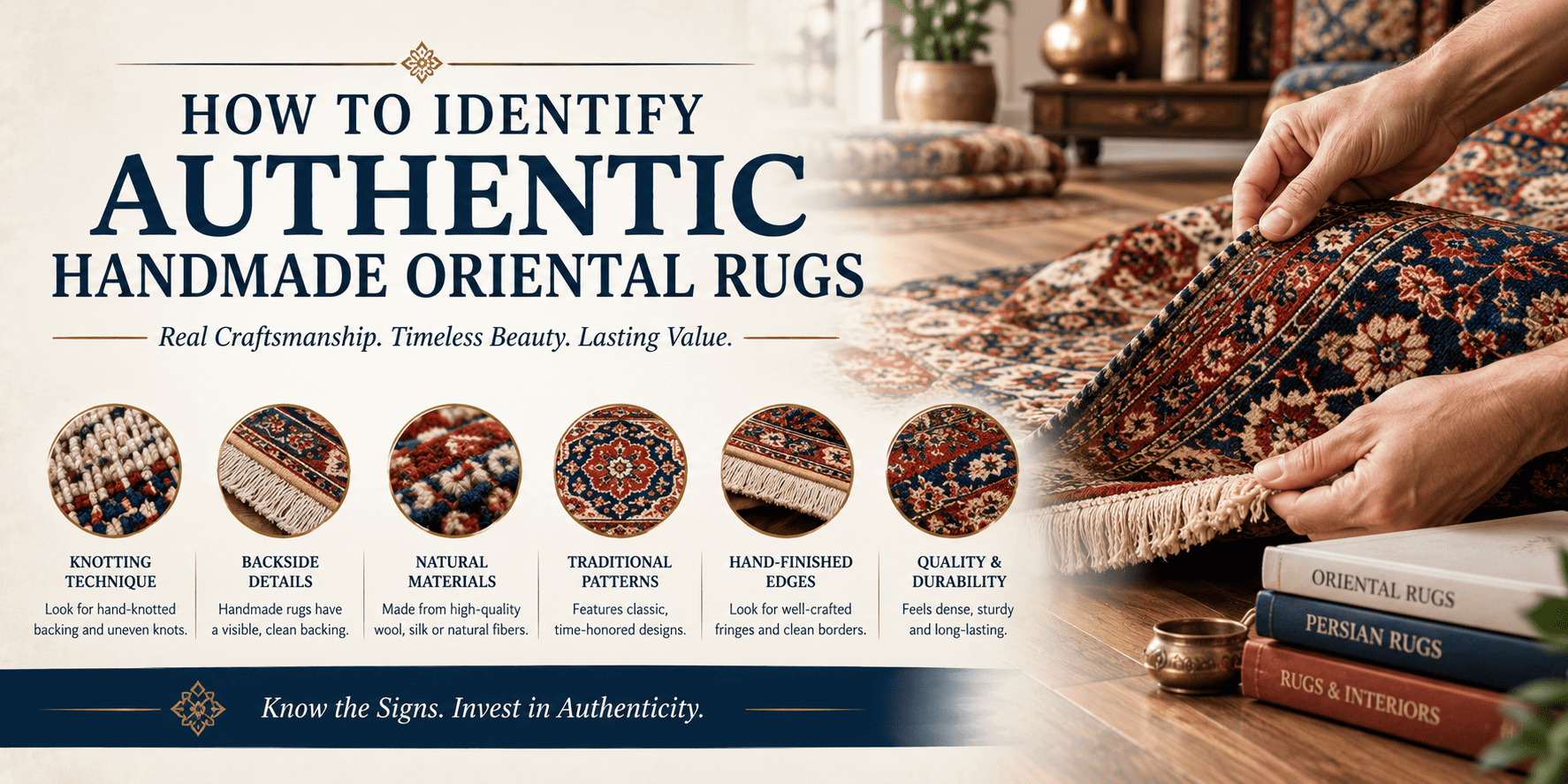
You can identify a genuine handmade Oriental rug by checking its back, knots, fringe, edges, materials, and overall construction. Evaluating the signs of authenticity is more reliable than judging the rug by its look, design, age, or price alone.
Whether you are purchasing a new Oriental rug for your living room or want to check the one you already have, knowing your options and what you are looking for can help you make a better and informed decision.
A handmade rug is made by hand, so it comes with slight variations. Handmade oriental rugs are produced individually, and each piece has unique construction, whereas machine-made rugs have uniform construction and usually appear more similar.
However, no single feature can prove authenticity. Checking multiple signs together can give you better clarity about the rug's construction and reliability.
Quick Tips:
Turn the rug and check the back for individual knots and a visible woven foundation representing handmade construction.
Check the fringe to see whether it is part of the rug’s foundation.
Look for some natural variations in knots, colors, and patterns.
Check the type of materials, such as wool, silk, or cotton.
Take expert help to check valuable or antique rugs.
A genuine handmade Oriental rug is a rug individually woven by hand by artisans using traditional weaving or knotting methods. “Handmade” is a broader term, while “hand-knotted” refers to a specific construction method that requires individual knots to make the rug.
Handmade rugs include hand-knotted, hand-tufted, and handwoven rugs. In a hand-knotted rug, the method is that artisans tie individual knots on foundation threads, while hand-tufted rugs are made by pushing yarns through a backing.
For buyers, this difference is important because hand-knotted rugs require more individual craftsmanship and have a different structure than hand-tufted rugs. That's why handmade rugs are more expensive.
You cannot ensure that an Oriental rug is handmade only by its pattern or design. Persian, Turkish, Caucasian, and Chinese designs can be copied and redesigned using machine-made methods.
A traditional medallion, floral border, or geometric motif may make a rug look genuine, but relying only on its appearance is not enough to ensure that it is handmade.
Modern rug producers can recreate cultural Oriental rug designs with excellent detailing. Instead of just relying on the pattern of the rug, you should check its actual construction.
The design can still give you proper signs about a rug’s culture or origin. A rug’s motifs, borders, colors, patterns, and other overall composition may highlight a particular weaving tradition and region.
You can use design as supporting clues instead of considering it as a sign of authenticity.
You can know the actual origin of an Oriental rug by observing its construction, design, patterns, knot structure, materials, colors, and available origin. These details work together to give better clarity than looks alone.
Let’s discuss the origin of each type of Oriental rug:
Persian rugs are traditionally related to Persia and include many different cultural designs. Their patterns and construction can sometimes showcase where they were produced.
Turkish rugs have many different weaving regions and may include geometric, floral, or medallion designs. Their knotting methods, materials, and patterns can help you know their traditional weaving regions.
Caucasian rugs are well-known for their dramatic geometric designs, strong colors, and unique motifs. Their construction and patterns give clues about their broader weaving tradition.
Chinese rugs usually consist of floral, symbolic, and decorative motifs inspired by Chinese art and culture. Their designs can indicate signs about origin, but construction should also be checked.
Before buying an Oriental rug, ask the seller to provide information about the rug's construction, materials, origin, condition, and other factors. These questions can help you avoid buying fake handmade oriental rugs.
When purchasing the rug online, ask for front and back side photos, and request a closer look at the back. A trusted seller will be able to answer all your questions regarding the rug’s construction, materials, and methods.
Let’s discuss each sign of authenticity:
If you are thinking of purchasing a rug online, ask for clear pictures of both the front and back sides. A close photo of the back side of the rug can help you check knots and construction before purchasing.
Check the rug's construction, whether it's hand-knotted, hand-tufted, handwoven, or machine-made. The word “handmade” does not mean that it’s hand-knotted. This helps you know what you are purchasing.
Always ask about the materials, pile and foundation are made of and the origin of the rug. For older rugs, also ask if the seller knows about its origin or has purchase records.
Ask about its actual age, wear, previous use, repairs, restoration history, fading, and overall condition. A handmade rug is not necessarily antique, vintage, or valuable.
The sign that proves a rug is fake or inauthentic is when the seller cannot clearly explain the rug’s construction, materials, origin, or condition.
Let’s discuss the other signs of a rug that is inauthentic or fake:
The seller avoids showing the rug’s back.
The fringe is separately attached.
The construction looks extremely uniform with no differences.
The seller does not know about materials.
A hand-tufted rug is described as hand-knotted.
Identical rugs are available in bulk quantity.
The rug price is unusually low for the stated age or craftsmanship.
The seller does not know the origin.
There are no details regarding construction.
Small variations are a part of handmade rugs, but imperfections alone cannot prove that a rug is handmade. As artisans make handmade rugs by hand, slight differences in knots, patterns, colors, and edges are common. Damage, uneven wear, repairs, or poor finishing are also signs of handmade craftsmanship.
However, every variation or imperfection does not mean the rug is authentic. Stains, worn areas, damaged edges, loose threads, and repairs may usually come from years of use. Look at the rug’s complete construction and natural variations in the weaving instead of looking for signs of damage.
Refer to this checklist before purchasing an Oriental rug or for checking the one you already have:
Individual knots should appear on the back.
The fringe should be tied to the foundation.
The edges should be properly hand-finished.
Small natural differences should be present in the rug.
Materials should be easily identified.
The pile and foundation should match the claimed construction.
The design should provide signs of regional traditions.
The seller should know and explain the rug’s origin.
The seller should provide construction details.
The price should reflect the rug’s age, material, size, and craftsmanship.
To know if you have a handmade rug, you can evaluate it by looking at its back, knots, fringe, edges, and construction.
Handmade rugs are different because they are individually produced and are uneven, unlike machine-made rugs that have a more uniform look.
Below are some characteristics that differentiate handmade and machine-made rugs:
Check the back of the rug: The handmade rug usually has single knots and a clearly visible woven foundation.
Inspect the knots: Handmade rugs have some differences in knot sizes and spacing.
Look at the fringe: The fringe is often attached to the back of a handmade rug, it is a part of the rug’s foundation.
Examine the edges: Hand-finished edges of a handmade rug have slight differences rather than being perfectly uniform.
Look for natural variations: Handmade rugs have some slight differences in pile color, pattern, and height.
Check the materials: Traditional handmade rugs are usually made of wool, silk, and cotton materials.
Learning how to recognize a genuine handmade Oriental rug starts with focusing on other factors rather than just relying on its look. Check the rug’s back, knots, fringe, edges, materials, and natural differences to understand its structure.
If you are buying a costly, aged, or elegant rug, ask the seller to share details about its origin, age, materials, and history. Checking all the factors of a rug and having its complete information makes you more confident about its authenticity and helps you make a well-informed decision.
Are you looking for a genuine handmade Oriental rug for your home?
Visit Magic Rugs, a trusted seller where you can find an exclusive variety of rugs and choose a genuine handmade Oriental piece that suits your room, style, and budget.
Explore Our Authentic Handmade Oriental Rugs
Turn the rug, look at its back, and examine its knots, foundation, fringe, and edges. Individual knots and natural variations can imply handmade construction.
Look at the back for individual knots tied on foundation threads. A handmade rug usually has a woven construction, unlike a uniform machine-made backing.
Yes, machine-made rugs can be a copy of traditional Oriental designs, colors, and textures. Always check the construction rather than only relying on the look of the rug.
On many hand-knotted rugs, the fringe is a part of the rug, tied around the foundation’s warp threads. However, the fringe can be replaced or repaired during the restoration process.
No, handmade Oriental rugs are not necessarily made from wool fiber, they can be made using silk, cotton, or combinations of fibers. The material is based on the rug’s style and construction.
No, KPSI (knots per square inch) measures knot density, not authenticity. A higher KPSI means finer weaving, but other factors of authenticity also matter.
No, traditional Oriental rugs’ patterns can be reproduced or copied using machines, so you can check the rug’s construction rather than looking at its appearance or pattern.
Handmade Oriental rugs can be expensive, but their prices vary. The rug’s size, material, craftsmanship, knot density, age, condition, origin, design, and rarity can all together affect the price.
Rug Guide
Rug Guide
Rug Guide