Cart (0)
No products in the cart.

Table of Contents
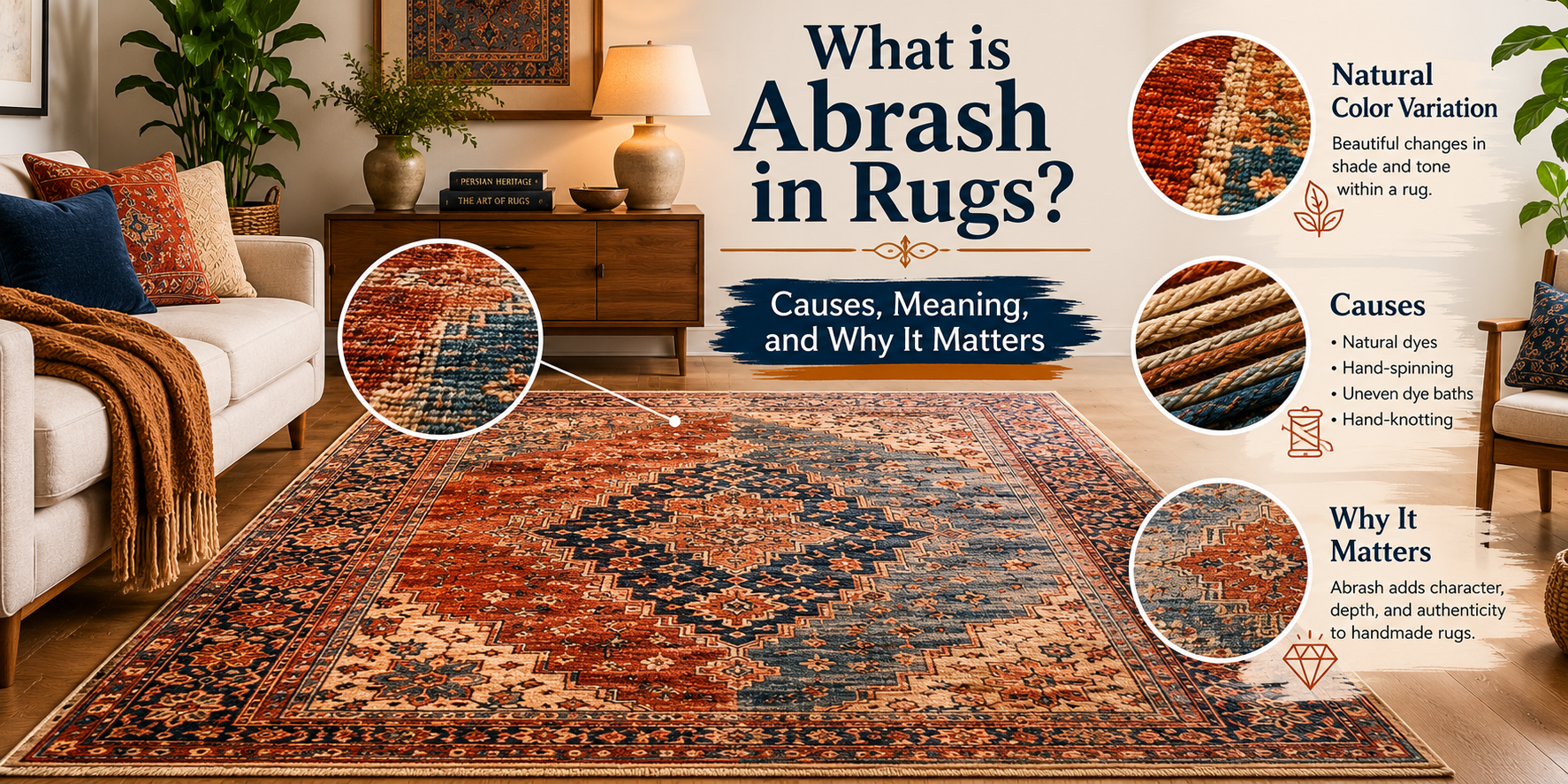
Abrash is often controversial and commonly misunderstood. We're going to tell you why abrash is actually something to look for in your rug.
Abrash is the natural color variation, or striation, that can be seen between fibers of the single intended color. It is a typical characteristic of a true handmade rug. You'll notice different shades of color in what should be a single color.
For instance, a rug that is supposed to have a bright red color has a touch lighter horizontal band somewhere. It looks like it came out of nowhere. People who don't know much about rugs might even think of it as a defect. But it's not. (More about this later)
| Did You Know? The word ‘Abrash’ has Arabic roots. It means ‘mottled’ or ‘speckled.’ It was passed from Arabic to Turkish as ‘Abraş,’ and later to Persian as ‘Abrashk.’ |
Abrash can happen due to a number of reasons, mostly associated with the dyeing process of the yarn.
1. Differences in dye lots.
Yarn is dyed in what we call dye lots. These dye lots can have different shades, especially when the process is done by hand. The dye solution itself could be slightly different from one batch to the next. As the rug weaver uses up one dye lot and begins to use another, you'll often notice a more prominent color variation at this juncture.
2. Leaving the yarn in for seconds too long.
Abrash can also be caused if one dye lot is left in the solution longer than the other. Even a difference of a few seconds can make the shade lighter or darker than expected.
3. Different absorption rate of the yarn.
The yarn's absorption rate may also differ depending on how tightly the yarn is wound and twisted. A flight change in the twist before dyeing, and you have a different color. Also, hand-spun yarns are not uniform. One batch can be thinner than the other or have a rough surface. This can also cause variations in the final color.
4. Natural dyes are highly sensitive.
Natural dyes are used for making premium handmade rugs. These dyes come from plants and minerals, such as indigo plant for blue, pomegranate skin for yellow, madder root for red, walnut husks for brown, etc. These dyes don't come out of a lab where every molecule is the same. The plants that grow in different soils and different years produce different shades of the same color.
You can spot abrash with your naked eye - no need for specialized instruments.
1. Look at large color fields
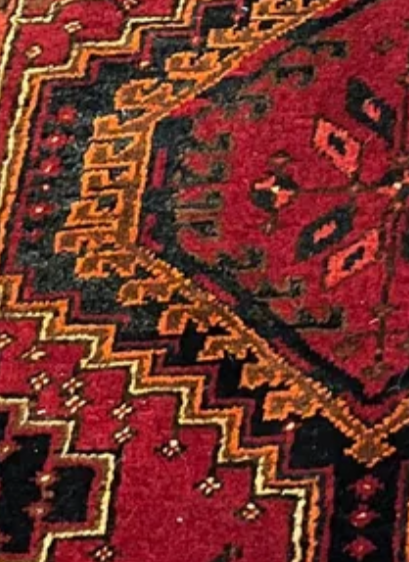
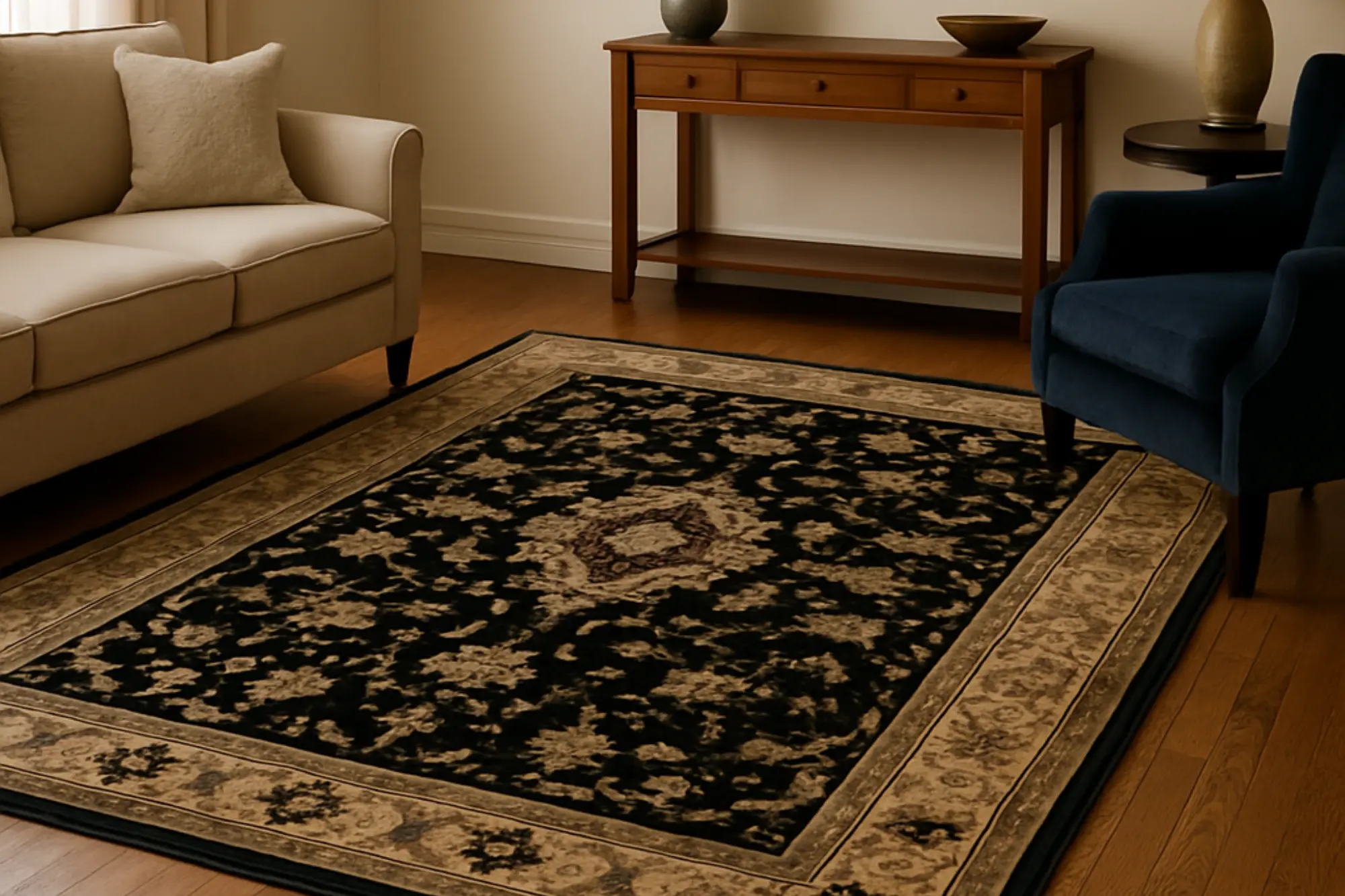
See how the black color is darker at the bottom and gradually appears lighter/greyish on the left. That is abrash. Real abrash flows in the field; it doesn't just snap
2. Look for horizontal bands
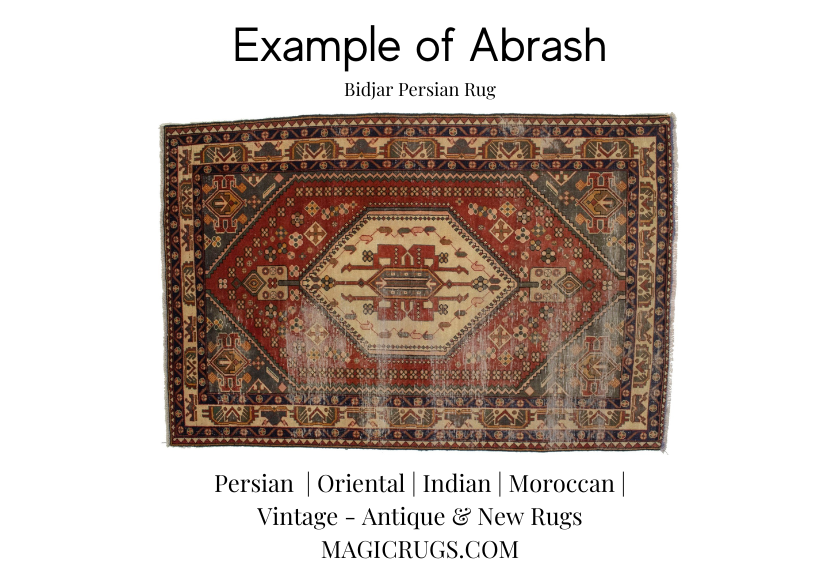
If you see a random horizontal patch on the rug that is lighter in color than the rest of the rug, that's abrash.
We often get asked, “Is this normal, or is something wrong with the rug?" And here's how we check whether the variation you are seeing is really abrash or something else:
| What You’re Seeing | What It Should Look Like | How to Confirm |
| Abrash | Soft, faded horizontal bands or color variations within one color field. | When you flip the rug, the same color variation should be visible on the back side. Or spread the pile open and check whether the color stays uniform from top to base to the fiber. |
| Sun Fading | Faded patches or spots with no fixed shape or orientation. | Sun fading should not be visible on the back when you flip the rug. When you spread the rug pile open, the color at the top of the fiber should be duller than the base. |
| Color Bleeding | Migration of a dye from one color to another, such as a red color creeping into the neighboring cream color. | Look at the edges between the two colors. With bleeding, the edges are blurred, whereas with abrash, they are crisp. |
| Defects | Irregular patterns or color shifts that do not follow the rug’s rhythm. | Compare the suspected area with a similar area on the rug to look for manufacturing defects. |
Abrash is not standardized in the rug world as happens because of small mistakes in the dyeing process. But abrash can be more prominent in certain rug types. Let's take a look.
Tribal rugs like Kazak, Bakhtiari, Afshar, and Qashqai are woven in small camps. They use hand-spun yarn dyed with local plants and minerals. So, abrash here can be very bold. You'll see wide bands of color shifts.
Village rugs, such as Heriz, Hamadan, and Bakshaish, have balanced abrash. You'll usually notice a band or two with subtle and soft variations.
Fine pieces made in large workshops like Tabriz or Kashan use larger dye lots. They have stricter quality control rules, so the variations in yarn colors are minimal. You may need to look very closely to spot abrash in these rugs.
Flatweave rugs like Kilim and Dhurrie have a flat structure. This leaves the color exposed without a deep pile to camouflage it. So, abrash can be spotted quite easily.
In antique and semi-antique rugs, abrash is more prominently visible than when it was made. Over time, the rug ages and the light color becomes even lighter.
No, abrash is NOT a defect. Having abrash in a rug does not affect its value in any way. In fact, having abrash is considered a good thing in the rug world. That is how you distinguish a truly handmade rug from a machine-made one. Machine-made pieces can never have that gradual and subtle color variation.
Many machine-made rugs try to mimic color striations, but unfortunately, the process is so digitised that the rug you get will always look like all the others. So, instead of thinking of it as a defect, think of it as a mark of authenticity of the rug.
Authentic oriental rugs are handmade using several batches of hand-dyed fibers. The hand-dyeing process doesn’t always yield consistent colors, as even a slight change in the dyeing process produces a different shade of the same color.
So, when a weaver changes the yarn, it could be of a slightly different shade than the previous one. This color variation can lead to a streak of a different shade on the rug, which we call abrash.
When you are buying a rug with abrash it means you are buying an authentic handmade rug. And there are a few things you can make to make sure it is abrash and not just sun fading.
The same color variation should be visible on the back of the rug.
Part the pile with your fingers and check whether the color is consistent from the top to the base of the rug. If not, it's sun fading.
If you are buying a rug with abrash from Magic Rugs, we are more than happy to show you the variation by sending you pictures and videos from various angles and lighting. We also clearly mention abrash in our listings, so you know what you are getting into.
We have been handpicking handmade rugs for almost two decades. Our experts do a thorough quality check to ensure the authenticity of the rugs and to check whether the abrash is real. We always describe abrash openly in all our rug listings. And we are more than happy to walk you through abrash on different rugs in detail. All you have to do is reach out to us with your queries.
Looking for rugs with abrash? Shop now from Magic Rugs.
No, all handmade rugs don't have abrash. It can develop over the years, in an authentic handmade rug, due to the fading of fibers.
Machine-made rugs do not have natural abrash. However, manufacturers can introduce a synthetic abrash-like structure to imitate the look. Induced abrash can be identified by flipping the rug over - the backside won't have the same color variations in a machine-made rug.
Yes, for sure. We always describe Abrash in the product details and provide photos on our website as much as possible. You can always get in touch with us, and we are happy to send more pictures or talk you through the exact condition of the rug you're shopping for.
The color variations due to abrash is from the base of the fiber to the top. Whereas, in sun fading, the color variation is only observed on the top part of the fiber.
‘Abrash' is pronounced as ‘uh-brash’ or sometimes ‘ah-brash.’ As long as you are using one of these, you are fine. We have had customers say it in five different ways at the showroom.
The different shades of stripes on your rug could possibly be from abrash. This is caused by the different batches of dyed fibers used to weave the rug.
Abrash gets more visible over time because different batches of fibers age differently. That means the color variation you see now will become more apparent in a few years.
Share: